
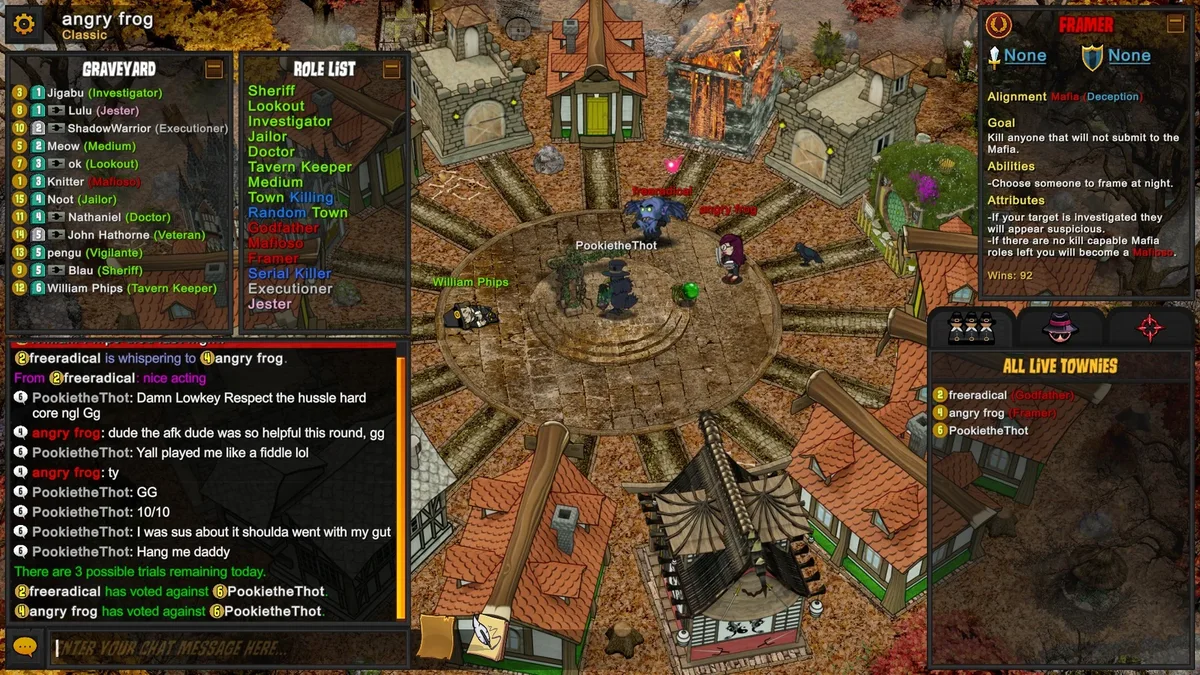
What a frame changes
- The frame is designed to corrupt Town investigative reads rather than directly kill.
- Mafia teammates know the frame plan and can exploit the resulting suspicion.
- Classic Mafia support/deception roles may be promoted if no dedicated killer remains.
Frames can outlast the night they were placed
A frame remains until an investigative check consumes it. A suspicious result on Night 3 can therefore come from an earlier frame, even when the Framer did not visit that target on Night 3. Compare the whole visit history before treating a quiet current night as an alibi.
Frame the player likely to be investigated
Early game
Frame players who are likely to be checked, not merely players you dislike. A visible counterclaim or a player drawing Sheriff attention is a better target than someone no investigator has reason to visit.
Mid game
Exploit the frame after a result appears. Mafia should not overreact with instant confidence; the most believable use is to let Town discover the contradiction and then support the wrong interpretation.
Endgame
When few players remain, a single false investigative result can decide the game. Target the person whose apparent guilt would create the cleanest miselimination without exposing why Mafia knew to frame them.
Keep your visit history plausible
Your public cover should not require visiting the same framed player in a way that Spy or Lookout can connect too neatly to Mafia activity.
Test framing as a specific explanation
Town should test suspicious results against the possibility of framing, especially when other mechanical evidence points the opposite way. Framing is an explanation to investigate, not a blanket excuse for every guilty player.
Important interactions
- Sheriff is the obvious victim of framing because a false suspicious result can drive a trial.
- Investigator groups may also be distorted depending on the active ruleset, so result guides should be checked for the mode being played.
- Spy and Lookout can expose Mafia movement around a player who suddenly produces misleading investigative feedback.
Decision example: framer target choice
A player has just counterclaimed a Mafia teammate’s investigative cover and is likely to be checked by Sheriff. Framing that player before the check can create a persuasive false suspicious result. If the Mafia instantly pushes before the Sheriff speaks, however, the coordination itself may become suspicious.
Common mistakes
- Framing random targets who are unlikely to be investigated.
- Using the frame as an all-purpose defense after a teammate is caught by multiple independent mechanics.
- Making Mafia day behavior too eager to capitalize on the result.
