
How the Coven works
The six Coven roles share a faction objective but create different night effects. Keep control, poisoning, hexes, protection and corpse use separate in your records. Expansion Town and Neutral roles are not Coven teammates just because they were introduced in the same expansion.
Coven Leader

The Town of Salem Coven Leader controls another player’s action and learns their role; the Necronomicon adds direct killing power.
Coven Leader chooses a player to control and a destination for that player’s action. The controlled role matters: redirecting a healer, an investigator and an attacker creates different outcomes. Role information helps the Coven choose future targets and prepare claims, but control immunity and the available action can limit a particular attempt.
With the Necronomicon, Coven Leader gains a Basic attack against the first target and Basic defense. This is separate from what the controlled player does to the second target. Track both selections when reconstructing a night instead of assuming that all deaths or visits came from one action.
Coordinate with teammates before redirecting a player into their target. A useful control can remove protection, contaminate an investigative report or expose a valuable role. For Town, preserve both a control message and the original intended action so other players can compare the redirection with independent results.
Potion Master
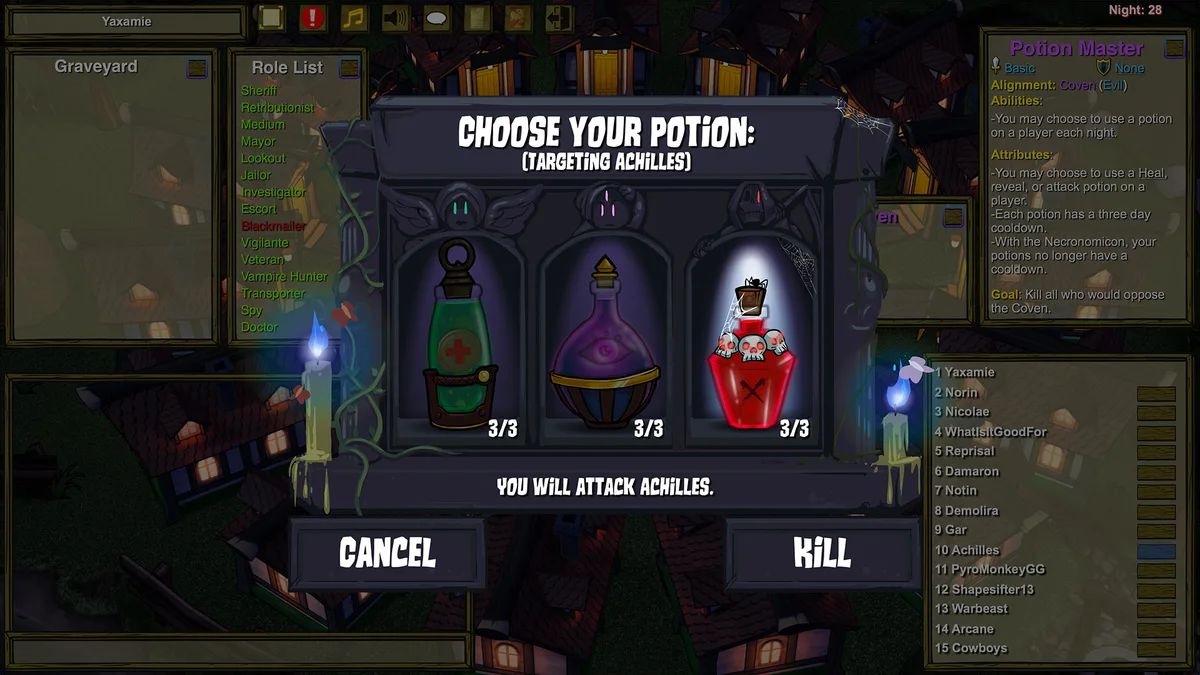
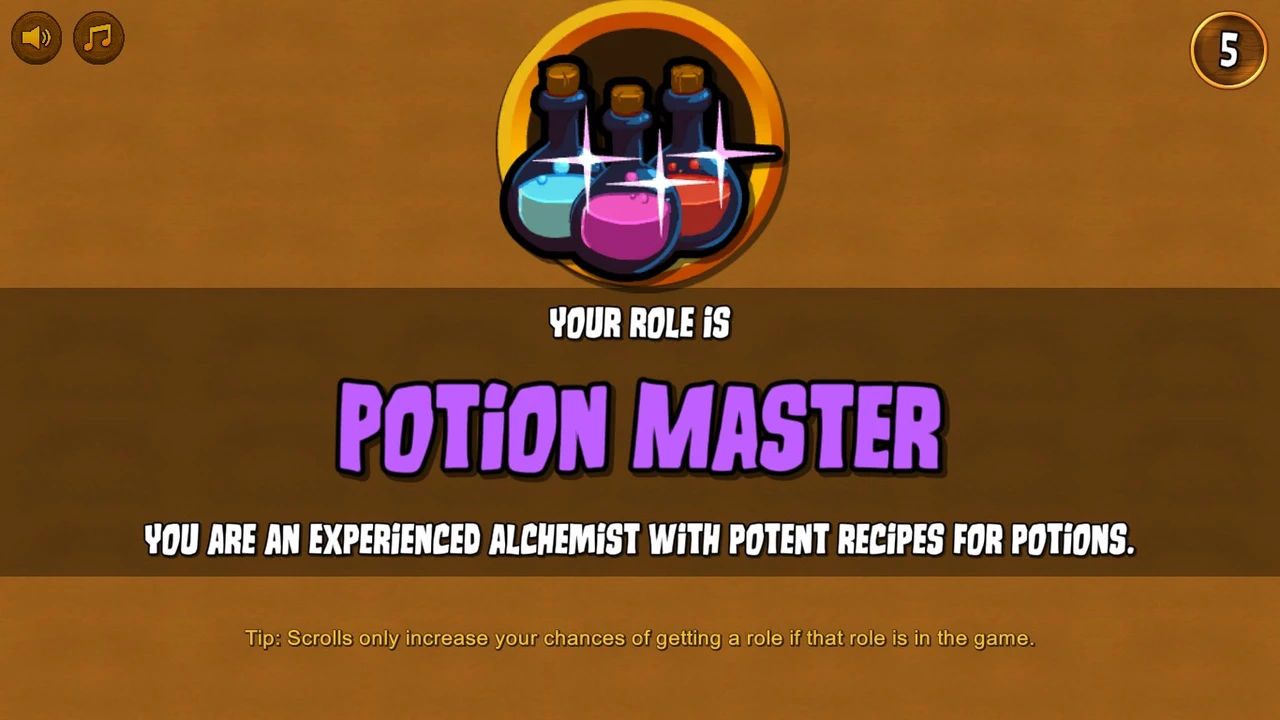
Choose between healing, revealing a role and attacking; manage each potion’s cooldown.
Potion Master has three distinct tools: a healing potion, a role-revealing potion and an attacking potion. Before receiving the Necronomicon, each potion has its own three-day cooldown. Using one kind does not mean every other kind has also been spent, so record the choice as well as the target.
A reveal can make the following night safer for the whole faction; a heal can preserve a teammate needed for the next day’s majority. Compare those outcomes with an immediate attack. Repeating an attractive potion before it is available produces an impossible claim history and an unusable plan.
The Necronomicon removes the potion cooldown restriction. Town should therefore keep the night number and possible book holder in view when testing consecutive actions. A claimed heal remains a claim to investigate: protective feedback does not by itself establish that the visitor was a Town Doctor.
Hex Master

Spread hexes and threaten the surviving opposition with a faction-wide finish.
Hex Master marks players with hexes. Those marks can distort investigative information, so a suspicious or altered result may describe an effect on the target rather than the target’s actual role. The Coven tracks hexed players because completing the marks on the living opposition can trigger its mass-kill condition.
Choose between adding a new mark and supporting the team’s immediate survival. A nearly completed set of hexes is of little use if the final Coven member is about to be voted out. Town should keep track of possible hex interference while still asking for complete claims and looking for evidence beyond one affected result.
With the Necronomicon, Hex Master adds an astral Basic attack to its action. Astral targeting does not behave like an ordinary visit, which matters to visitor-based evidence and retaliation. A missing Lookout visit is therefore not enough to rule out this upgraded attack.
Necromancer

Use eligible corpses as night abilities and build a plan around the graveyard.
Necromancer selects an eligible dead role and a target for that corpse’s ability. Used corpses rot and cannot simply be recycled every night. The graveyard is therefore a changing supply of actions, not merely a record of players who can no longer affect the match.
Read what the chosen corpse can actually do. A corpse’s investigation, protection or attack must be interpreted through that role’s restrictions, and some dead roles are unsuitable for the intended action. Keep the corpse name, destination and result together when planning with the Coven.
The Necronomicon provides an additional route to a Basic attack through a summoned ghoul. For Town, an action associated with a dead role does not prove that someone returned permanently to life. Compare Necromancer and Retributionist explanations with the available corpses, faction claims and earlier uses.
Poisoner

Apply delayed poison and track whether treatment is still possible.
Poisoner places a delayed lethal effect on a player. The poison warning and the later death belong to different moments in the match, so keep the application night in the will. Before the Necronomicon upgrade, timely healing can answer poison; after the upgrade, the poison cannot be cured in the same way.
The delay creates planning choices. Coven can poison one target while using another ability elsewhere, but must still account for the victim’s next day of voting and information. Poisoning an already doomed player can waste an opportunity to change the following night’s balance.
A reported poison message is not sufficient to identify Poisoner when Hypnotist is possible. Ask what happened afterward and whether independent evidence supports a real effect. As Town, report the warning promptly enough for a healer to act when a cure is still available, without claiming that every claimed cure confirms a Doctor.
Medusa

Stone visitors with limited gazes and hide information from their deaths.
Medusa can use a stone gaze at home, threatening visiting players. It begins with three gazes, so an active night and an inactive night carry different risks. Stoning conceals the victim’s role and will, removing information that Town would normally receive from a death.
A convincing public claim can attract exactly the visitors Medusa wants. Town investigators and protectors should assess that risk together instead of independently visiting the same doubtful claim. If a player is stoned, leave the missing information unresolved rather than inventing a role to fill a slot.
With the Necronomicon, Medusa can visit a target and stone them. The upgraded action changes the pattern from waiting for visitors to creating a direct threat. Track book timing when explaining deaths, and distinguish Medusa’s information removal from Janitor cleaning or Forger falsifying a graveyard entry.
When the Coven receives the Necronomicon
The Coven receives the Necronomicon from Night 3. Its holder gains a role-specific upgrade and protection from Sheriff detection. That is not universal immunity to investigation, voting or every attack. Keep the holder’s possible powers and the exact night in view when comparing results.
Use the Coven Investigator result groups alongside the role list. An altered result can be consistent with a hex or another deception effect; it still needs an explanation that fits visits, claims and deaths.
