
Why trials create better evidence than ordinary chat
Chat is cheap; a vote changes the board. Good trial strategy therefore treats nomination and judgement as information-generating actions, not just the final step after a read is complete. Who starts a wagon, who joins only after consensus, who resists a claim check and who changes position after new evidence appears can matter as much as the final result.
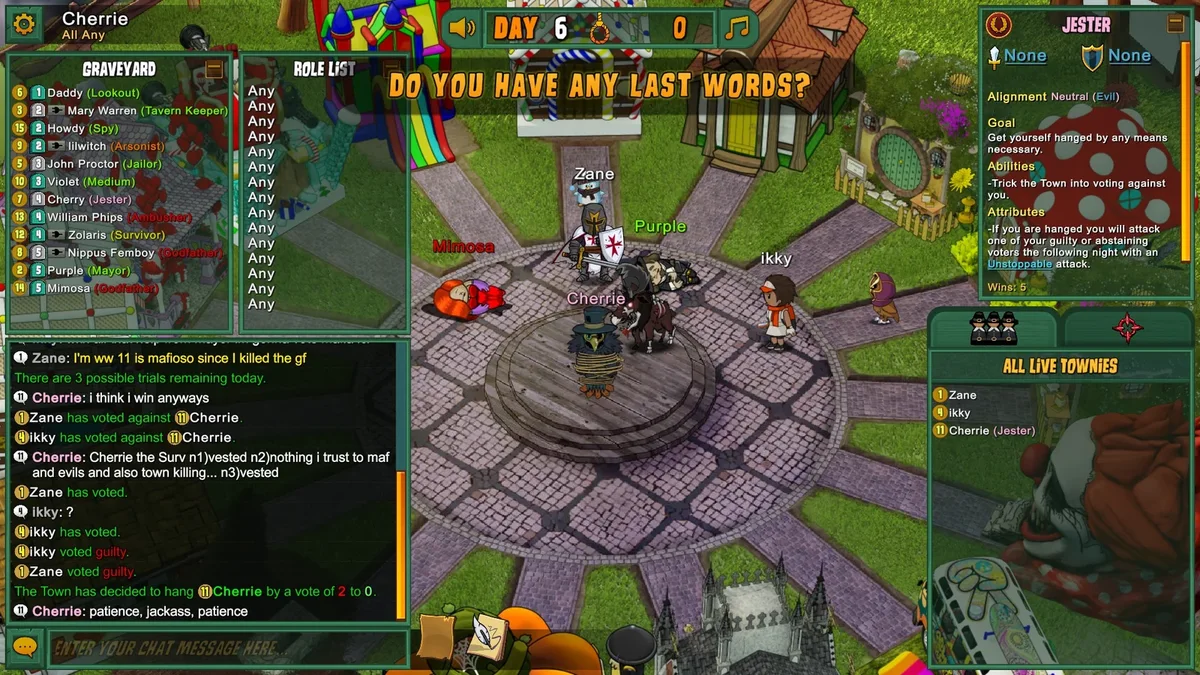
Town of Salem VFR / Vote for Role
Vote for Role, or VFR, uses nomination pressure to collect claims when there is no stronger lead. Good VFR has a purpose: reduce claim space, create a timestamped statement and move on when the answer is testable. Bad VFR becomes random execution pressure with no plan for checking the claim.
The defense phase
The defense phase is short, so the accused player should give a chronological claim instead of a speech about personality. A useful defense usually contains role, night-by-night targets/results, any relevant feedback and one explanation for the contradiction that caused the trial. Town should compare that defense with what was said before the player reached the stand.
The judgement phase
The judgement phase asks a different question from “do I dislike this claim?” Ask whether guilty is the best available action given the role list, graveyard, night power and parity. Innocent can be correct when another test is available; guilty can be correct when delaying gives an evil faction a forced win. Abstains are also data, especially in close wagons.
Reading the vote map
Track early nominations, the vote that reaches the trial threshold, and attempts to redirect the wagon. Record the announced guilty/innocent split separately; it is not a timestamped account of everyone’s private judgement choice. One vote is weak evidence. A pattern across several days becomes stronger when it repeatedly protects the same factional interests. Do not turn vote reading into a rigid rule: Town can vote badly and evil players can bus teammates.
Late-game voting
In the endgame, calculate the consequence of the vote before debating tone. Model who is alive after the execution, who can kill or protect at night, and whether the next day begins at parity. That is why voting strategy and endgame strategy should be studied together.
Nomination and judgement use different thresholds
Nomination requires more than half of the living voting power to put a player on trial. During judgement, conviction requires guilty voting power to exceed innocent voting power; an equal guilty/innocent total acquits. Abstaining contributes to neither side. A revealed Mayor contributes three votes, so headcount alone can be misleading.
Example without a revealed Mayor
With seven living players, four nominations put a player on trial. At judgement, two guilty votes, one innocent and three abstentions convict the defendant. Two guilty and two innocent acquit, even if the remaining players abstain. The defendant does not cast a judgement vote.
