
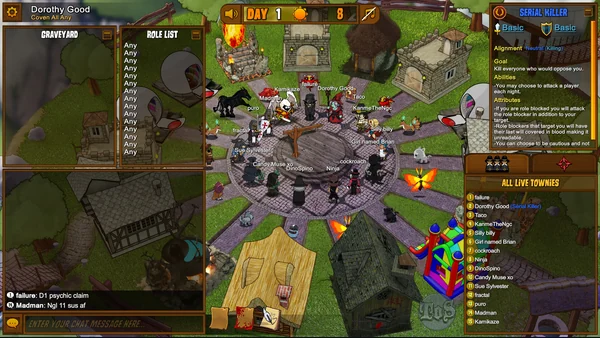
1. Read the setup and role card
The lobby determines which roles are possible. When the game starts, your role card tells you alignment, ability and goal. Those three pieces answer the first strategic question: who can win with you, what information or power do you control, and what must happen before the game ends?
2. Use the night phase deliberately
Most active roles choose a target at night. Investigators gather clues, protectors try to prevent kills, support roles redirect or block actions, and killers select victims. Record the target before the night resolves so your will reflects the decision you actually made.
3. Read the morning information
Deaths, wills, role flips and night feedback change the board. Compare what happened with yesterday’s claims. If a player said they would heal the victim, a protection failure may matter; if a role was cleaned, claim space becomes more uncertain because Town does not know what slot died.
4. Discuss claims before voting
The day phase is where private actions become public evidence. Ask for role, targets and result wording. Test whether claims can coexist with the role list and with visit/control information. A trial is strongest when Town already knows exactly what it wants the accused to explain.
5. Win for your alignment, not for your ego
Town tries to remove criminal and evil threats; Mafia coordinates kills and deception; Neutral roles may have independent objectives. A clever personal read is irrelevant if the action helps the wrong faction reach parity. Always connect the next move to your actual win condition.
One full cycle
You are Doctor. On Night 1, choose Player 5 and record the target. At dawn, read your own feedback before the public death list: a message that your target was attacked supports a protection event. Player 8 dying elsewhere does not show whether 5 was attacked or identify who killed 8. During discussion, compare 5’s claim with other records while keeping your heal target and any feedback intact.
Your first day: a practical sequence
- Read your role card and write the win condition in your own words.
- Prepare a will with a role name and a blank Night 1 line.
- When the ability window opens, read the targeting prompt; some roles choose during the day and others at night.
- At dawn, copy your feedback and then read the deaths and wills.
- Post information your role needs to share, request missing claims and separate nomination pressure from a guilty verdict.
For short chat terms such as TI, RT and CC, use the abbreviation reference. Keep the will formats nearby until the routine becomes familiar.
Common mistakes
- Ignoring the selected role list.
- Forgetting to update the last will after the night.
- Voting before asking for the accused player’s full claim.
- Playing for another faction’s objective after your own role is known.
