
The graveyard is a changing role-list constraint
Town of Salem graveyard strategy begins with a simple habit: recalculate the board after every revealed death. A confirmed role can close one claim path, open another counterclaim, or make yesterday’s “possible” story mechanically impossible today.
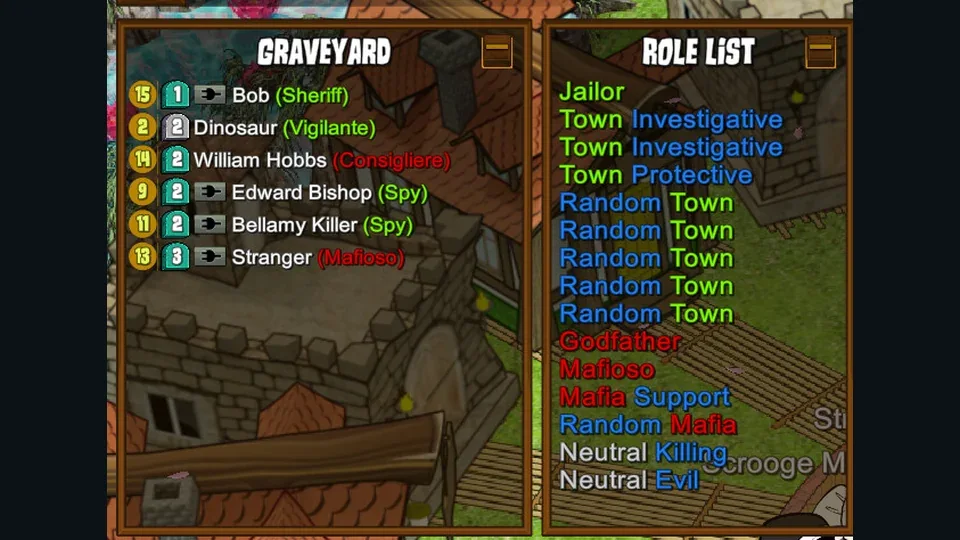
Confirmed role versus confirmed alignment
Write what the graveyard actually confirms. A revealed role can be more useful than a behavioral read because it reduces the remaining role pool. But unusual modes, cleaned information or deception mechanics can affect what the table knows, so label uncertainty explicitly instead of filling gaps from memory.
Use dead wills as timestamped records
A last will is valuable because it preserves information after the player can no longer change their story. Compare the dead player’s log with living claims, visit information and the sequence of public messages. A will is evidence, not sacred truth: evil roles can write convincing records too.
Claim-space compression
Town of Salem claim space becomes easier to solve when you mark roles as confirmed dead, credibly claimed, mechanically contradicted or still open. You are not merely asking whether one claim could exist; you are asking whether all current claims can coexist.
Cleaned or hidden information
When a death does not reveal everything the table normally expects, keep an explicit “unknown graveyard slot.” Do not allow several living players to use the same missing information as unlimited claim room. Track which stories require that unknown slot and which do not.
Endgame use
Before a final vote, reconstruct the remaining plausible roles from the graveyard upward. This is often safer than starting with living players and guessing alignments from tone. The dead roles tell you which win conditions and night powers can still exist.
Forger can change the displayed role
A forged death can show both a false role and a false will. Do not always treat the graveyard’s role label as a perfectly reliable way to close Random Town slots. Compare what the player claimed before death and any surviving independent records. A cleaned or stoned death instead conceals the information.
