
Separate wagon roles
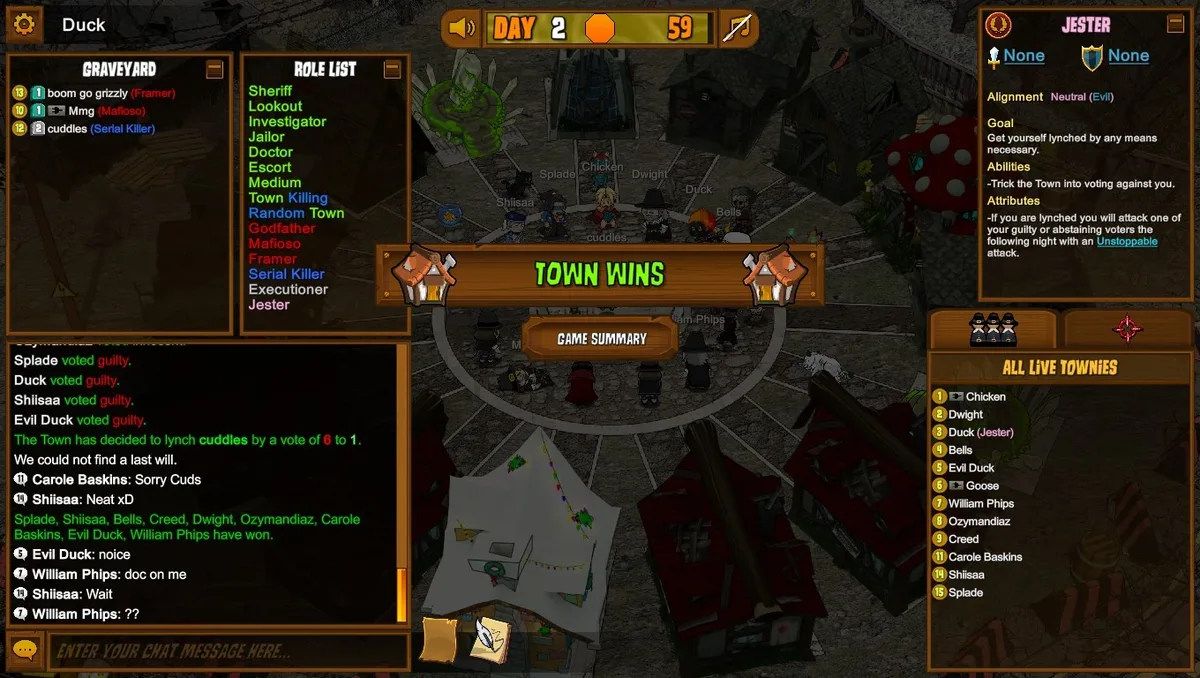
Identify the starter, early supporters, middle joins, final safe votes and players who resisted. Those positions carry different incentives. A teammate may bus early for credibility or join only after the elimination becomes inevitable.
Record what changed before a switch
A vote change after a new Sheriff result is different from a switch with no new information. Ask what event justified the move. Behavioral evidence is strongest when the timing lacks a reasonable Town explanation.
Study saves as well as guilty votes
Who pulled pressure away from a future Mafia flip? Did they offer a mechanical reason or merely open a second wagon? Repeatedly redirecting from teammates can reveal associations even when each individual defense sounds plausible.
Do not overvalue the final vote
The last nomination on a doomed evil player can be nearly costless for a teammate. Earlier resistance or a failed attempt to redirect the day may be more informative than appearing among the guilty voters after judgement.
Re-read old wagons after flips
A vote record becomes more valuable when alignment is known. Once a player flips Mafia, revisit who protected, pushed, abandoned or reluctantly joined that wagon. Use the pattern to generate questions, then verify them with claims and mechanics.
Safe-join example
Player 9 defends Player 6 while nomination votes are still accumulating. After 6 posts a contradictory will, 9 supplies the final nomination needed for trial and later appears among the guilty voters. Separate those two records: the nomination’s timing is observable, while the verdict result does not tell you when every other player chose guilty. Ask what evidence caused 9’s change before interpreting it as distancing.
Common mistakes
- Clearing someone because they voted an evil player.
- Ignoring what new information caused a vote switch.
- Treating one association as proof without mechanics.
- Reading only guilty votes and not the attempts to save a wagon.
