
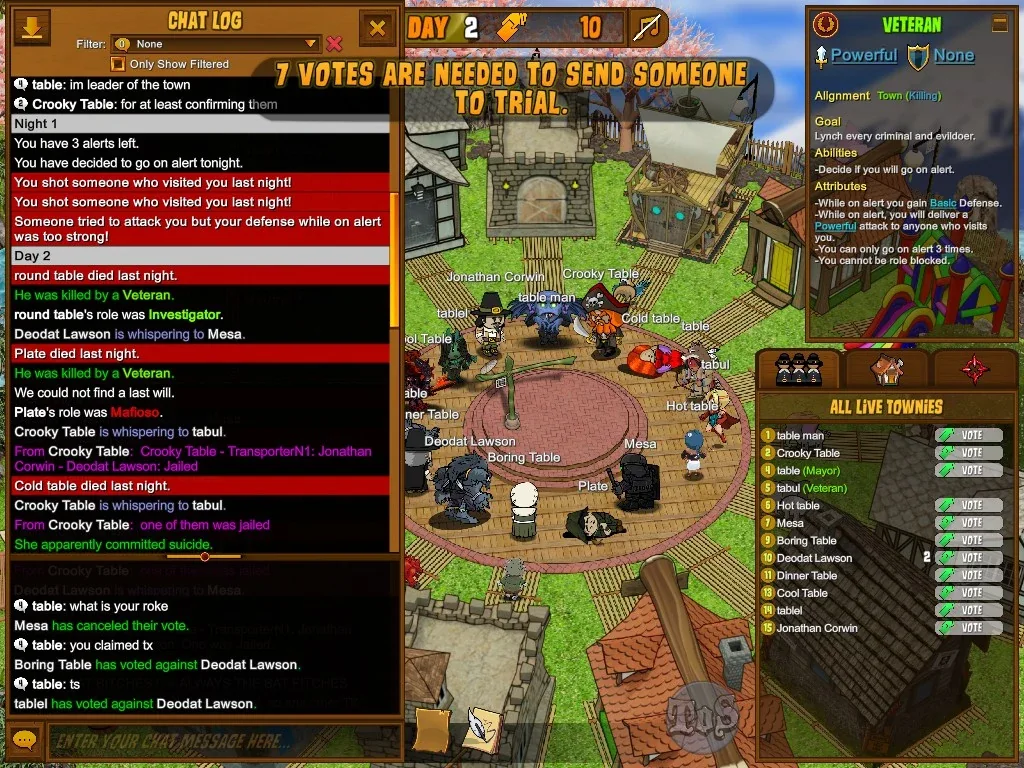
What VFR is supposed to accomplish
The purpose is information compression. Town selects a player, applies enough pressure to require a claim, records the answer and moves on if the claim is plausible. A successful VFR round can expose duplicate roles before any trial becomes irreversible.
Pressure is different from conviction
Voting someone toward trial can be a tool even when you are not sure they are evil. Once the player claims, reset your evaluation. Continuing the wagon because “we already started it” turns an information strategy into lazy tunneling.
Choose an order that reveals useful conflicts
Random VFR can expose roles, but claim order matters. Asking unresolved quiet slots before already-confirmed voices can reveal counterclaims without giving every liar a perfect template from earlier claims.
Read who resists and who rushes
Players who refuse all claim pressure may be protecting an evil cover—or a sensitive Town role. Players who rush every VFR target to guilty may be using Town’s information process as cover for easy miseliminations. Behavior matters after the mechanical claim is recorded.
Stop VFR when the board is already solved
If a hard contradiction, confirmed evil result or parity emergency exists, collecting one more random role wastes the day. VFR is useful when Town needs structure, not when the next correct action is already mechanically clear.
Safe VFR sequence
Town pressures Player 4 to claim. Player 4 posts Doctor with a three-night target log. No counterclaim appears and the role list allows it, so Town records the claim and moves to Player 7. Later, a Lookout contradiction points back to Player 4. The earlier VFR claim becomes useful because it was preserved before the contradiction existed.
Common mistakes
- Treating VFR votes as evidence of guilt.
- Continuing to guilty after a plausible claim just because the wagon is close.
- Letting late claimers copy every earlier role before they are asked.
- Using VFR when a stronger mechanical case already needs the day.
