
Start with raw outputs
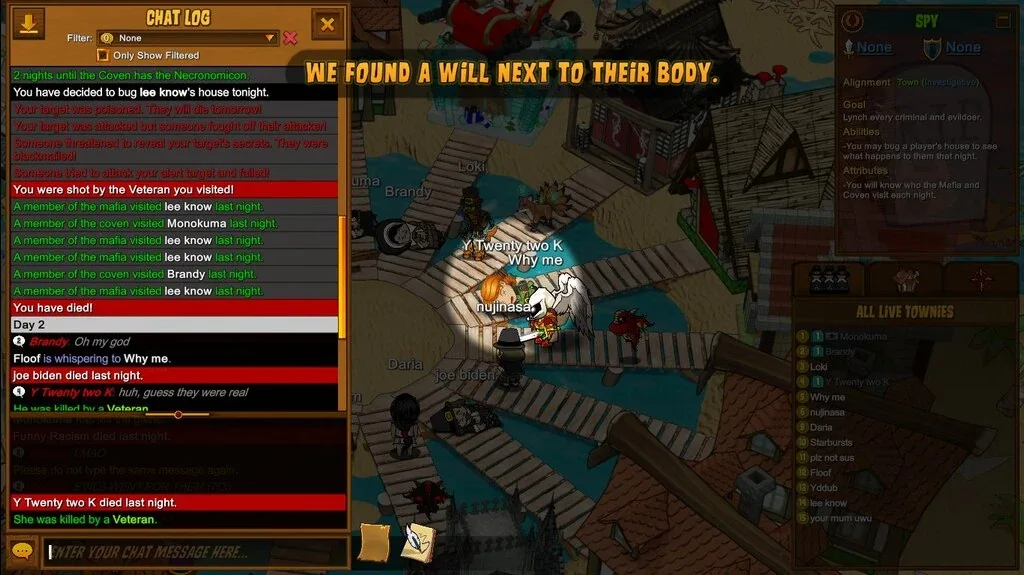
Write what each role actually saw: Sheriff suspicious/innocent, Investigator group, Lookout visitors, Spy faction visits. Do not convert those outputs into alignment conclusions until the raw records are side by side.
Look for independent confirmation
A Doctor claim and a Lookout seeing that Doctor visit the protected player are two different mechanics. A Sheriff result repeated by a second player who only copied the first claim is not independent evidence. Ask whether the sources could be wrong for the same reason.
Resolve redirection before contradiction
Transporter or Witch control can change the recipient of an action. A roleblock can prevent an action instead of redirecting it. When two logs disagree, reconstruct the action path first. Calling one claimant fake before resolving redirection can eliminate a real investigative role.
Use the graveyard to narrow old results
An old result can become more useful as confirmed information consumes available slots. Remove a role from the possibilities only when the configured list has no legal copy left. A role appearing in the graveyard does not by itself exclude another copy, particularly in All Any.
Publish the chain in a compact form
When asking Town to act, show the connection: “Sheriff found 9 suspicious; Lookout saw 9 visit the victim; 9’s claimed role should not visit.” The chain is persuasive because each part answers a different question.
Three-source chain
Sheriff reports Player 10 suspicious. Lookout watched the Night 2 victim and saw Player 10 visit. Player 10 claims Survivor, a role that did not need to make that visit. None of those clues alone is perfect; together they create a strong mechanical case worth a full trial.
Common mistakes
- Counting copied claims as independent evidence.
- Skipping Transporter/control resolution.
- Forgetting that old Investigator groups become narrower after flips.
- Presenting conclusions without the raw result chain.
Look for an independent source, not an echo
After collecting the chain, challenge its shared assumptions. Disguiser can alter a Lookout identity and a frame can alter a Sheriff result. Ask whether an alternative accounts for both observations on the same night. A consistent alternative reduces confidence; an unrelated list of theoretically possible exceptions does not explain the actual record.
