
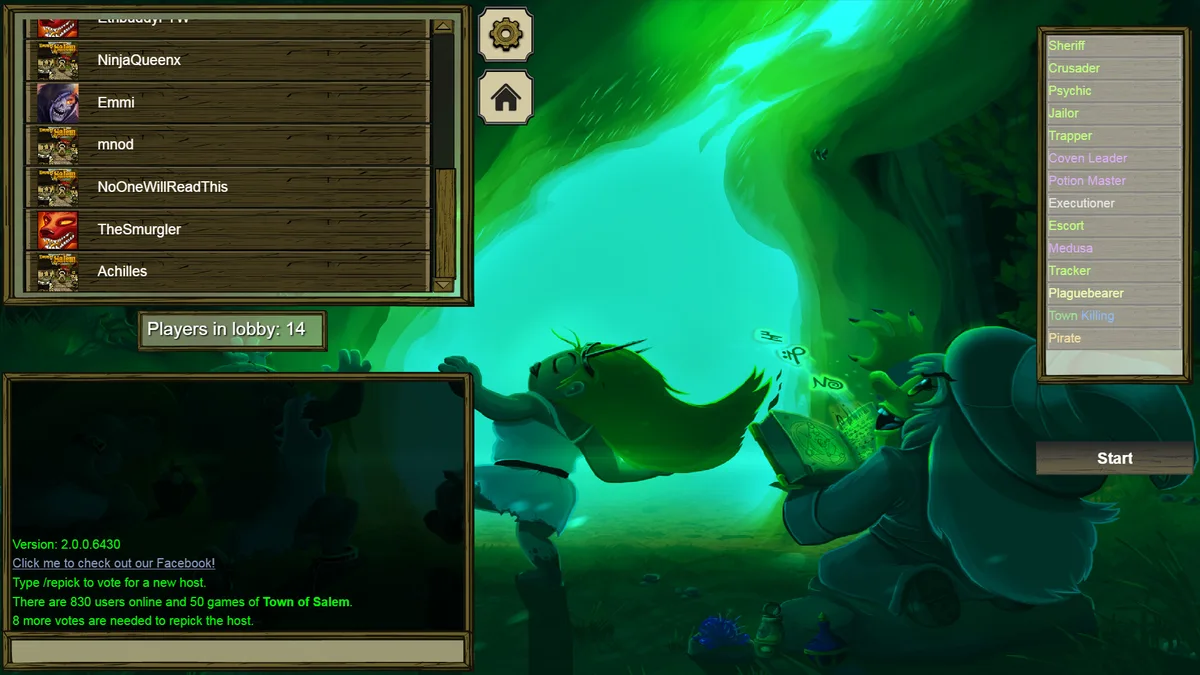
Separate expansion mechanics from game mode rules
The Coven Expansion adds roles and interactions; a specific Coven lobby determines which of those roles are actually possible. Do not treat “Coven exists” as proof that every expansion role is in the match. Read the selected role list first.
Expect more complex investigative ambiguity
Additional roles widen result groups and create more believable cover claims. Investigator and Sheriff results should be interpreted with the exact Coven table for the ruleset being played rather than a Classic-only cheat sheet.
Necronomicon changes role behavior
Several Coven roles gain stronger or different effects when holding the Necronomicon. That means the same role can produce different feedback later in the match. Claims should note when an action occurred relative to Necronomicon possession.
Control and protection interactions become denser
Coven introduces more ways to redirect, poison, hex, reanimate or otherwise modify night actions. Before declaring a result impossible, resolve Transporter, roleblock, control, protection and Coven-specific effects in a consistent order.
Claim space expands—and so does fake-claim room
More legal roles mean more plausible stories. Town should rely less on “that role probably is not in the game” and more on chronological logs, visitor evidence and the selected setup. Evil players, meanwhile, gain cover options but also more mechanics they must imitate correctly.
Classic knowledge is not enough
A player using only a Classic Investigator table may call a Coven result impossible when the expansion adds another role to the group. The correct response is not to memorize every table from memory: verify the active ruleset, then interpret the result against that specific list.
Expansion roles outside the Coven team
| Role | What changes | What to verify |
|---|---|---|
| Psychic | Receives group visions rather than selecting one exact-role check | Which night produced the vision and which names it contained |
| Tracker | Reports where a target visited | The tracked player and reported destination |
| Crusader | Protects a target and threatens a visitor | Protection and visitor deaths are separate observations |
| Trapper | Builds and places a persistent trap | When it was built, placed and triggered |
| Guardian Angel | Protects an assigned person rather than serving Town as a faction | The assigned objective and any completed protection |
| Pirate | Pursues successful duels | The duel outcomes and personal progress |
| Juggernaut | An independent killer whose abilities develop with kills | The stage of the threat rather than an assumed fixed profile |
| Plaguebearer | Spreads infection before becoming Pestilence | Transformation is a change of state, not an automatic victory |
These roles are not members of the six-role Coven faction. Compare the active lobby’s allowed pool before using any of them as a cover or explaining an unusual result.
Common mistakes
- Mixing Town of Salem 2 role behavior into Town of Salem 1 Coven rules.
- Assuming every Coven role is possible in every Coven lobby.
- Ignoring Necronomicon timing when checking a claim.
- Using Classic-only investigative results in expansion games.
Separate Coven teammates from expansion additions
The Coven faction has six roles: Coven Leader, Potion Master, Hex Master, Necromancer, Poisoner and Medusa. The expansion also contains Town and Neutral roles with different objectives. Pirate and Guardian Angel are not Coven teammates. Ambusher and Hypnotist were made available to the base-game role pool by patch 3.3.0.
Use the Coven role reference for individual powers and the Coven Investigator column for compatible claims. Patch 3.3.15 also improved party access to Coven mode selection; ownership still matters.
