
Mistake 1: keeping useful results private
Investigative information becomes less believable when it appears only after pressure starts. If your role is expected to produce public results, prepare them before discussion. A short “N1 – Player 7 – suspicious” is more useful than a long defense posted after the wagon is already at trial.
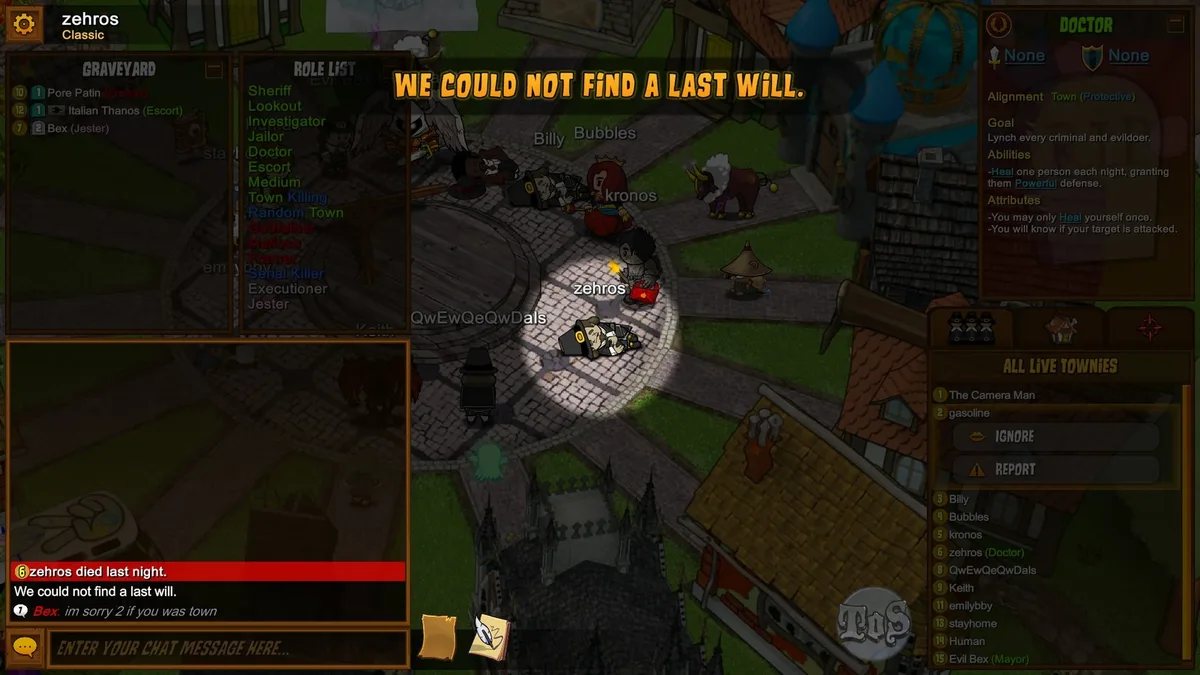
Mistake 2: treating the will as optional
A last will is the game’s memory. Without it, your death erases targets, results and reasons that Town could have cross-checked. Even passive or neutral roles benefit from a clean chronology because it prevents others from inventing your history after you die.
Mistake 3: confusing compatibility with confirmation
An Investigator group that includes the claimed role means the claim is compatible; it does not prove the role. An innocent Sheriff result has exceptions. A visit seen by Lookout proves movement, not alignment. Beginners should ask what the clue rules out rather than what they want it to prove.
Mistake 4: choosing targets without a question
Night actions should test something. Investigate a disputed claim, protect a likely kill target, block a player whose action matters, or watch a house expected to receive traffic. Random targets make it harder to interpret the result because there was no hypothesis in the first place.
Mistake 5: forgetting parity
Late-game votes change the number of surviving votes before the next night kill. Count living factions first. A correct suspicion can still be the wrong elimination if it gives another evil faction immediate majority control.
Replace one bad habit at a time
If your first problem is forgetting wills, do not also try to master every investigation table in the same session. Play three games with one rule: update the will immediately after every night. Once that becomes automatic, add a second habit such as checking the graveyard before each vote. Improvement is faster when the process itself becomes reliable.
Common mistakes
- Trying to solve tone before recording mechanics.
- Copying another player’s claim format without understanding the result.
- Assuming loud players are more trustworthy than quiet ones.
- Saving every ability charge for an ideal moment that never comes.
